The permanent collection — plus this season's live anomalies at the end.
4 records found
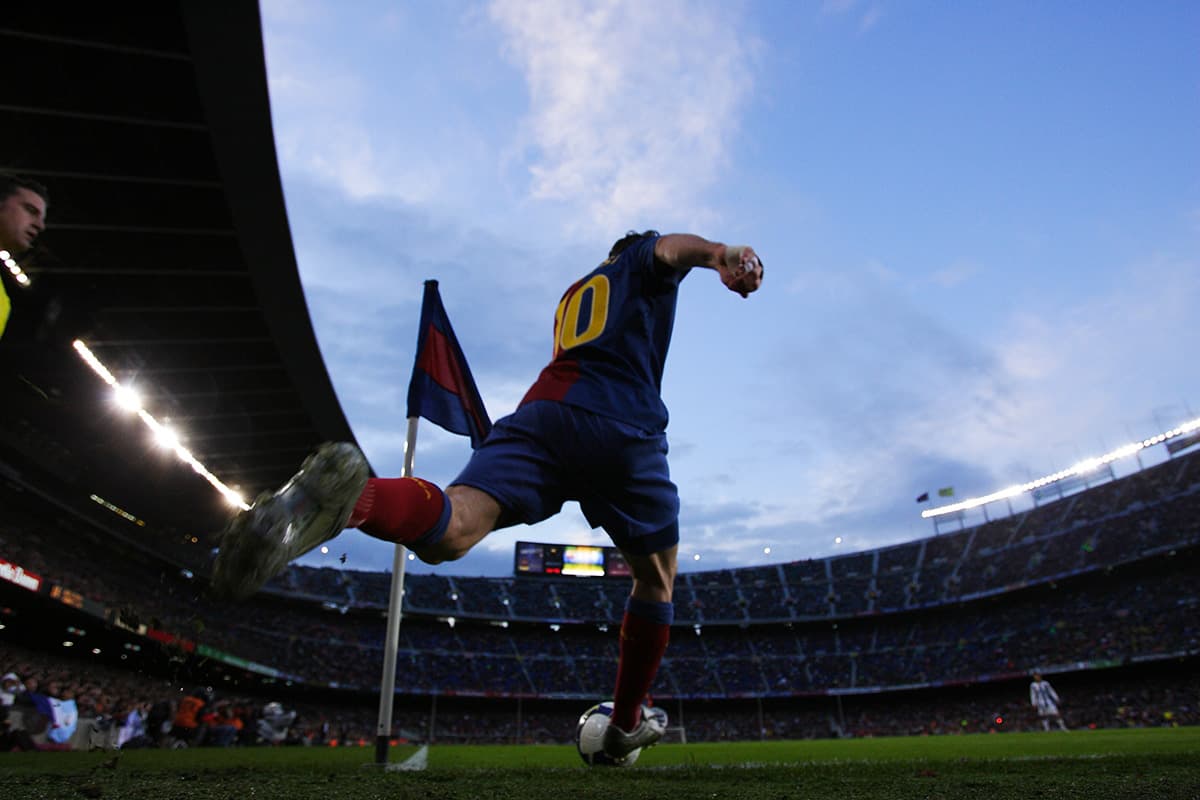
While the concept of a deep-dropping striker has historical precedents, Pep Guardiola and Lionel Messi modernized the role at Barcelona. Operating as a False Nine, Messi would nominalize himself as a central striker before dropping deep into midfield. This movement presented opposition center-backs with a difficult choice: step forward to follow him, which vacated space behind the defensive line for inverted wingers to exploit, or remain in position, allowing Barcelona to establish a numerical midfield overload. This positional deception turned the striker role from a physical focal point into a primary playmaker, changing how modern defenses organize their central coverage. The False Nine became the defining tactical innovation of Guardiola's Barcelona era, dismantling teams who relied on compact central defensive blocks.
In 2012, Lionel Messi shattered Gerd Müller's long-standing record of 85 goals in a calendar year. Playing for Barcelona and Argentina, Messi scored 91 goals in 69 appearances — a feat that required sustaining a goal-scoring rate of over 7 goals per month against modern defensive setups for 12 consecutive months.
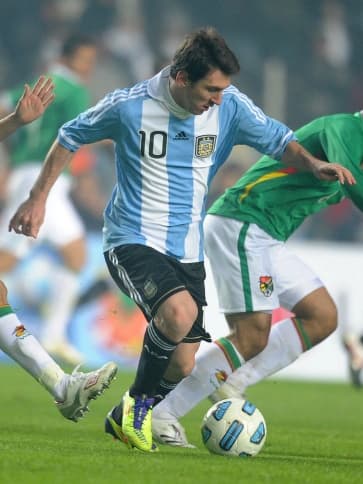
Lionel Messi's dribbling style is characterized by elite biomechanical efficiency and rapid neuromuscular coordination. Standing at 1.77 meters, Messi has a low center of mass, positioned approximately 0.9 meters from the ground. This low center of mass minimizes his rotational inertia, allowing him to absorb and redirect ground reaction forces (GRF) during rapid cuts. This efficiency reduces his turn latency by 0.2 to 0.3 seconds compared to taller professional peers. Biomechanical analysis reveals that his step ground contact time ranges between 0.12 and 0.15 seconds, significantly below the typical 0.18 to 0.20 seconds of average professional players. Additionally, his electromechanical delay (EMD)—the time between neural activation and muscle force output—is estimated at 40 milliseconds, far below the standard 60-millisecond threshold, enabling rapid, unpredictable changes of direction. Beyond his physical acceleration, Messi's dribbling is guided by highly developed visual-motor coupling and sensory systems. Eye-tracking studies demonstrate that Messi does not fixate on the ball during active dribbling; he looks at the ball less than 30 percent of the time. The remaining 70 percent of his gaze is dedicated to monitoring the positioning of opponents and identifying vacant spaces. This skill relies on advanced vestibular-cerebellar integration, which maintains his equilibrium and visual stability during rapid movement, supported by highly developed proprioception allowing micro-adjustments to his touch without visual confirmation.
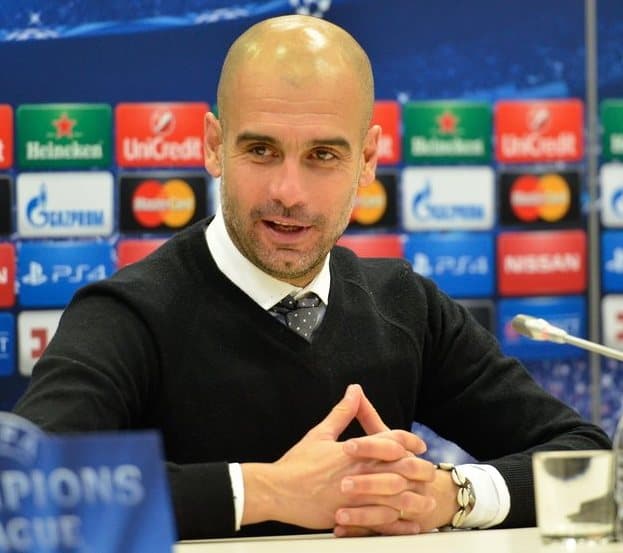
Between 2008 and 2012, Pep Guardiola's Barcelona and the Spain national team dominated global football through Tiki-Taka, a possession-oriented tactical system built on short, rhythmic passing combinations and positional manipulation. The system adapted the core principles of Total Football, utilizing the 'third-man run' to bypass defensive lines and secure numerical overloads in midfield. Rather than passing merely to retain possession, Tiki-Taka aimed to draw opponents out of their defensive shapes, creating vertical passing lanes into central spaces. The system relied on technical precision, high positioning, and immediate recovery of the ball upon losing possession, setting a new standard for technical football. The greatest proving ground was the UEFA Champions League, where Barcelona's midfield mastery — orchestrated by Xavi, Iniesta, and Busquets — dismantled opponents who sat deep in compact blocks.